


International football brings together teams with different traditions, tactical approaches, and competitive ambitions. A matchup between Australia and Brazil is particularly interesting because the two national teams have developed their football identities in different environments. Australia is known for its physical commitment, disciplined defending, and determination, while Brazil has built a global reputation for technical ability, creative attacking play, and individual brilliance. Whenever these nations meet, supporters have an opportunity to see contrasting football philosophies compete on the same pitch.
The Australia vs Brazil matchup attracts attention because Brazil has historically been one of the strongest teams in international football, whereas Australia has established itself as a respected competitor in Asian and global tournaments. Their encounters can offer valuable lessons about tactical organization, possession, pressing, and the importance of taking chances in front of goal. Although the teams have different records and resources, international football regularly demonstrates that preparation, confidence, and teamwork can influence the outcome of any match.
Overview of Australia and Brazil National Football Teams
Australia’s men’s national football team, commonly called the Socceroos, represents Australia in international competitions. The team has participated in multiple FIFA World Cups and has become a consistent presence in Asian football since joining the Asian Football Confederation in 2006. Australian football emphasizes collective effort, physical endurance, tactical discipline, and the ability to compete against technically gifted opponents. The national team has also benefited from players gaining experience in European and other international leagues.
Brazil’s men’s national football team is among the most successful teams in the history of the FIFA World Cup. Brazilian football is associated with skillful dribbling, quick combinations, attacking movement, and the ability to create scoring opportunities from difficult situations. Over several generations, Brazil has produced outstanding forwards, midfielders, defenders, and goalkeepers. Its football culture places considerable emphasis on creativity, although modern Brazilian teams also rely on structured defending, tactical flexibility, and physical preparation.
The contrast between these teams makes their meetings appealing to neutral fans. Australia often aims to remain compact and organized, while Brazil generally has the technical quality to control possession and create opportunities through intricate attacking movements.
Australia vs Brazil Head-to-Head Record
The historical record shows Brazil holding the advantage over Australia in senior men’s international football. Brazil’s technical quality and attacking depth have often made the difference, although Australia has demonstrated that disciplined defending and effective counterattacks can challenge even elite opponents. Previous encounters include international friendlies, FIFA World Cup matches, and Confederations Cup fixtures, providing several examples of how the two teams approach different competitive situations.
One of the most memorable results came in June 2001, when Australia defeated Brazil 1–0 in the FIFA Confederations Cup third-place playoff. That victory remains an important moment in the Socceroos’ football history. Brazil subsequently won their 2006 World Cup group-stage meeting 2–0 and recorded a 4–0 victory in a 2017 friendly. More recently, the September 2026 friendlies produced a 1–1 draw followed by a 4–2 Brazilian victory. These results illustrate both Brazil’s historical advantage and Australia’s ability to compete strongly on particular occasions.
Selected Previous Results
| Year | Competition | Result |
|---|---|---|
| 1997 | FIFA Confederations Cup | Australia 0–0 Brazil |
| 2001 | Confederations Cup third-place playoff | Australia 1–0 Brazil |
| 2006 | FIFA World Cup | Brazil 2–0 Australia |
| 2013 | International friendly | Brazil 6–0 Australia |
| 2017 | International friendly | Australia 0–4 Brazil |
| 2026 | International friendly | Australia 1–1 Brazil |
| 2026 | International friendly | Australia 2–4 Brazil |
Source: Historical match records and reports. The table highlights selected senior men’s international fixtures rather than every meeting.
Playing Style and Tactical Differences
Australia generally relies on a balanced approach that combines defensive structure with purposeful forward movement. The team often looks to maintain compact distances between defenders and midfielders, reduce space around the penalty area, and challenge opponents for second balls. When possession is recovered, Australia can move quickly into attacking positions using wide players, forward runs, and direct passes. Set pieces are also important because aerial strength and organized routines can create scoring opportunities against teams that otherwise dominate possession.
Brazil traditionally prefers a more technical style. Its players are comfortable receiving the ball under pressure, combining in tight spaces, switching play across the pitch, and creating chances through dribbling or quick passing. Brazilian teams can attack centrally or use the wings to stretch opposing defences. However, a possession-based approach also requires good defensive balance because losing the ball high up the pitch can leave space for counterattacks.
In an Australia-Brazil contest, the tactical battle often depends on whether Australia can remain organized without becoming too passive. Brazil will look for gaps between defensive lines, while Australia needs to make its counterattacks count. Winning midfield duels, controlling transitions, and defending the penalty area effectively can be just as important as individual technical ability.
Key Players and Match-Winning Qualities
Individual performances can transform international matches, particularly when one team has greater attacking depth. For Australia, pace, work rate, aerial strength, and intelligent movement are valuable qualities. Players who can carry the ball forward and maintain possession under pressure help the team move beyond its defensive shape. Accurate delivery from wide areas and well-timed runs into the penalty box can also provide opportunities to score.
For Brazil, creative midfielders and dynamic forwards often play decisive roles. Players capable of beating defenders one-on-one can force opponents to adjust their defensive shape, creating room for teammates. Accurate finishing, quick combinations around the box, and movement between defensive lines make Brazil dangerous even when chances are limited. Experienced defenders and reliable goalkeepers are equally important when opponents launch counterattacks.
Current selections and starting lineups can change with injuries, club commitments, tactical decisions, and international schedules. Therefore, supporters should distinguish between historically influential players and those actually selected for a particular fixture. The most useful way to assess the teams before kickoff is to examine their confirmed squads, recent performances, player fitness, and expected formations.
Important Match Statistics to Compare
Statistics help explain why a match develops in a particular direction. Possession is one useful indicator, but it does not automatically determine which team is more dangerous. Brazil might control the ball for longer periods, while Australia could create high-quality chances through transitions or set pieces. The number of shots on target, defensive recoveries, and successful entries into the penalty area can provide a clearer picture of the contest.
Supporters comparing the teams should pay attention to these indicators:
-
Possession percentage: Shows which team controls the ball for longer.
-
Shots on target: Helps measure how effectively each side tests the goalkeeper.
-
Expected goals (xG): Estimates the quality of chances created, when the statistic is available.
-
Passing accuracy: Indicates how successfully teams circulate possession.
-
Corners and set pieces: Reveal opportunities to exploit aerial strength and rehearsed routines.
-
Defensive errors: Highlight mistakes that can change the result.
-
Counterattacks: Show how effectively a team attacks immediately after winning possession.
No single statistic tells the complete story. A team may have fewer shots but create the clearest opportunities, while another may dominate possession without converting that control into goals. Combining statistical indicators with tactical observation gives supporters a more accurate understanding of performance.
FIFA World Cup History and International Importance
The FIFA World Cup provides an important context for understanding the difference between Australia’s and Brazil’s football histories. Brazil has won the men’s World Cup five times, making it the most successful nation in the tournament’s history. Australia, meanwhile, has developed into a regular World Cup participant and has reached the knockout stage, including the round of 16 in 2006 and 2022. These achievements reflect different stages of football development rather than a lack of ambition from either side.
Their World Cup meeting in Germany in 2006 was a significant occasion for Australia. Brazil won 2–0 in the group stage, but Australia remained competitive and eventually advanced to the round of 16. For Brazil, the tournament represented another opportunity to demonstrate its ability to perform on the biggest international stage. For Australia, facing elite opponents helped strengthen its reputation as a team capable of challenging established football nations.
The wider importance of this fixture extends beyond tournament results. Matches against high-ranking opponents allow Australia to evaluate its defensive organization and attacking efficiency. Brazil can use such encounters to test combinations, assess emerging players, and prepare for future international competitions.
Strengths and Weaknesses of Both Teams
Every national team has strengths that can influence a match, as well as weaknesses that opponents may try to exploit. Australia can benefit from physical intensity, collective discipline, aerial ability, and a willingness to work hard without possession. These characteristics are especially valuable when facing technically superior opponents. However, prolonged periods of defending can create fatigue, and inaccurate passes during transitions may prevent Australia from relieving pressure.
Brazil’s principal strengths include technical quality, attacking creativity, depth across several positions, and the ability to create scoring opportunities from individual actions. Its forwards can stretch defensive lines, while its midfielders can control the tempo. Nevertheless, Brazil must remain alert to fast counterattacks and avoid giving opponents unnecessary space behind advancing defenders.
| Category | Australia | Brazil |
|---|---|---|
| General approach | Organized and energetic | Technical and attack-minded |
| Defensive priorities | Compact shape and collective effort | Structured defending and pressing |
| Attacking strengths | Transitions and set pieces | Dribbling, passing and creativity |
| Potential challenge | Sustaining possession under pressure | Managing counterattacks |
| Main tactical objective | Limit space and exploit openings | Create chances and control the game |
These are general characteristics, not guarantees of how either team will play in every fixture. Coaches can adjust their tactics according to their opponents, available players, and competition requirements.
What Can Decide a Future Australia vs Brazil Match?
A future Australia vs Brazil match could be decided by several factors, including early goals, midfield control, defensive concentration, and the effectiveness of substitutions. If Brazil scores early, Australia may have to attack more aggressively and leave additional space behind its defensive line. If Australia remains level deep into the second half, pressure can increase on the more heavily favoured side, particularly in front of a demanding crowd.
Set pieces may provide Australia with a practical route to goal, especially if its defenders and midfielders can attack crosses effectively. Brazil, in contrast, may seek to exploit individual matchups on the wings and create overloads near the penalty area. Goalkeeping performances could also prove decisive if one team produces numerous shots but struggles to finish.
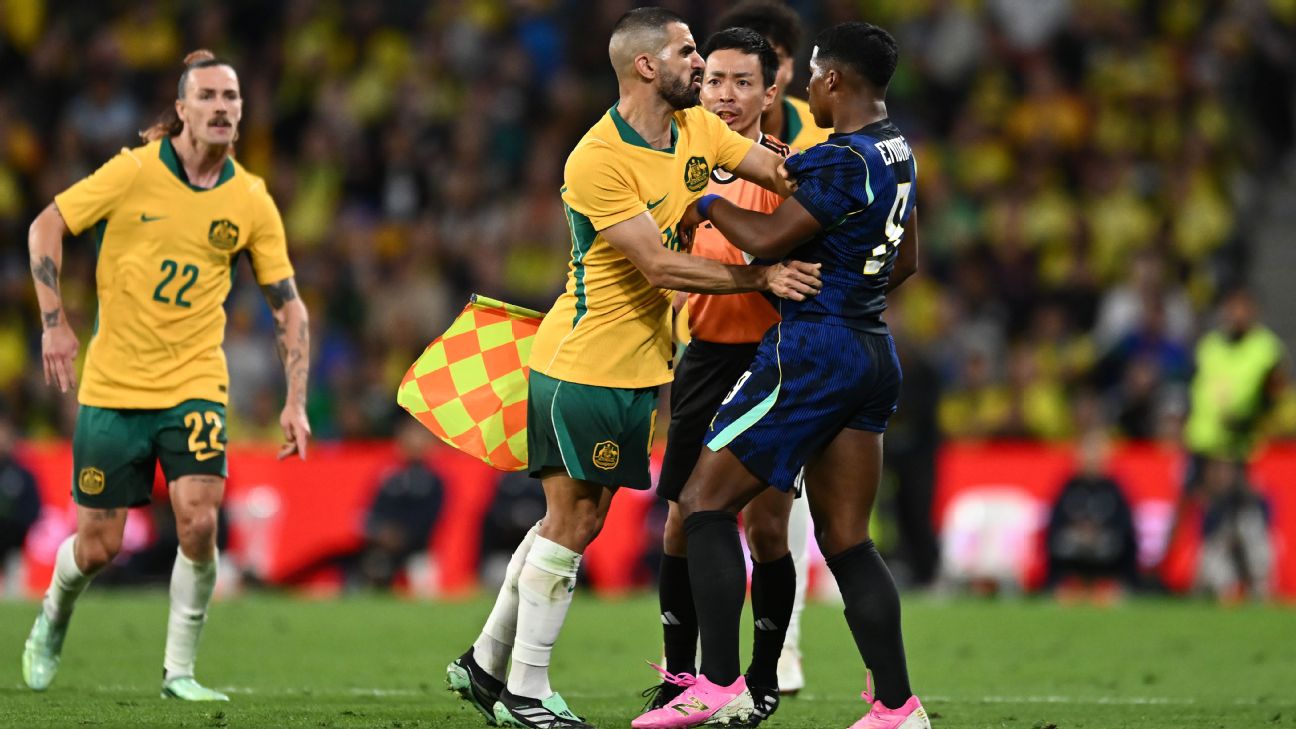
The latest 2026 meetings illustrate the importance of concentration until the final whistle. Australia drew 1–1 with Brazil on September 25 after Nestory Irankunda scored from a free kick and Brazil equalized through Rayan in stoppage time. Four days later, Brazil recovered from falling behind to win 4–2, demonstrating its attacking resilience.
Why Football Fans Follow This Matchup
This international matchup appeals to different types of football supporters. Brazilian fans expect creativity, technical excellence, and attacking football, while Australian supporters value determination, collective effort, and opportunities to challenge a world-class opponent. Neutral viewers can enjoy the contrast between these approaches and watch how tactical decisions shape the game.
The fixture is also useful for younger players, coaches, and analysts studying international football. It demonstrates how teams with different resources and playing traditions can approach the same challenge. Australia can learn from facing elite attacking players, while Brazil must adapt to opponents who defend compactly and compete aggressively for possession.
For fans following the game, the most informative details include the confirmed lineups, formation changes, substitutions, goal timings, and post-match statistics. These elements explain not only who won but also why the result occurred.
Conclusion
Australia and Brazil represent two distinct football traditions, making their international encounters compelling for supporters around the world. Brazil’s rich World Cup history, technical ability, and attacking depth give it a strong historical advantage, while Australia’s organization, physical commitment, and counterattacking potential can create difficult situations for any opponent.
The Australia vs Brazil rivalry has already produced memorable results, including Australia’s 2001 Confederations Cup victory and the closely contested friendlies of September 2026. Those encounters demonstrate that historical records provide context, but each new match creates its own challenges and opportunities.
Ultimately, the outcome depends on preparation, tactical discipline, individual performances, and the ability to convert chances. Whether supporters are studying previous results or anticipating another international meeting, this matchup offers an engaging example of how contrasting football philosophies compete at the highest level.

